Score Breakdown
- Fun from the very first map to the very last
- Brilliant day/night loop of building and defending
- Challenge scales naturally from approachable to demanding
- Every weapon and perk combination feels viable somewhere
- Mutators turn good maps into great tactical puzzles
- Excellent value for the price
- Some maps have clearly dominant strategies on base difficulty
- Late game challenges require very specific strategies
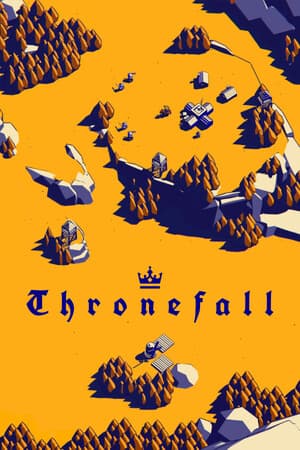
Thronefall is a minimalist strategy game where you build a kingdom by day and defend it by night. It strips the genre down to its core decisions and makes every single one matter. The result is one of the most consistently fun strategy games in years.
The Good
The day/night loop is the foundation and it is perfectly tuned. During the day, you ride between building slots on horseback and place structures. Houses for income. Towers for defense. Barracks for troops. Every slot is a commitment because gold is scarce and there is no undo. When night falls, waves of enemies rush your kingdom and you fight alongside your army to survive until dawn. The cycle repeats, pressure grows, and your earlier decisions compound.
What makes it work is how readable the strategy is. You can see your entire kingdom at a glance. You know where the enemies are coming from, what your weak points are, and what you need to fix next morning. There is no fog of war, no hidden information, no micromanagement. Just clean decisions with clear consequences. When you lose, you know exactly why. When you win, you earned it.
The difficulty curve is one of the best I have seen in the genre. Early maps teach the fundamentals gently. Place some houses, build a tower, swing your sword at a few barrel knights. By the midgame, you are managing economy against military pressure while choosing between upgrading defenses or investing in troops. The late maps demand real tactical planning. Enemy compositions shift, attack vectors multiply, and the margin for error shrinks. It never feels unfair. It just asks you to think harder.
Weapons and perks create genuine build diversity. The nine unlockable weapons change how you fight as the warrior king. A battleaxe plays differently from a blood wand, and both demand different perk loadouts and building priorities. With over fifty perks to mix and match, the combinations are deep enough that the same map can play very differently depending on your setup. Some runs feel like aggressive cavalry charges. Others are careful siege defenses where you barely swing your weapon.
Mutators are where the real depth lives. These optional modifiers ramp the difficulty and change the rules. Faster enemy waves, restricted building options, stronger bosses. They transform maps you have already cleared into entirely new puzzles. A map that felt comfortable on base difficulty becomes a tight optimization problem with two or three mutators active. This is where the game's design shines brightest. The core loop is simple enough that every added constraint creates a distinct challenge instead of just making things harder.
Pacing deserves its own mention. Individual runs are short. A full map takes fifteen to twenty minutes, and restarting is instant. There is no lengthy setup phase, no tutorial interruptions, no waiting. You are making meaningful decisions within seconds of starting a new run. That loop makes it dangerously easy to say "one more try" at midnight.
The presentation matches the design philosophy. Low-poly visuals are clean and charming. The soundtrack shifts between calm building phases and tense combat, and both moods land. It looks and sounds like exactly the game it is.
The Not So Good
On base difficulty, some maps settle into dominant strategies once you find the right build order. The opening few runs on a new map involve real discovery, but the optimal path can become obvious. Mutators fix this entirely, but the base campaign could push more variation on its own.
Ten maps is a solid amount, but the game's systems are strong enough to support more. Every map has its own terrain, enemy types, and building layout, and each one feels distinct. That quality makes you want another ten.
Recommendations
Just play. The opening maps are welcoming and the game teaches through doing, not through menus. You will understand the loop within your first run.
Prioritize economy early. Houses and income buildings pay for themselves quickly, and a strong economy gives you options on later nights. It is tempting to build military first, but gold solves more problems than one extra tower.
Experiment with every weapon and playstyle. The battleaxe, the bow, the blood wand. They all feel different and they all have maps where they shine. Do not commit to a single favorite early. The game rewards players who adapt their approach to the map and the mutators active. A setup that carried you through Wildbach might crumble on Nordfels.
Verdict
Thronefall is the rare strategy game that is fun from the moment you start and only gets better as the challenge scales up. The minimalist design is not a limitation. It is the reason every decision feels important, every loss feels fair, and every victory feels earned.
Play it. Bring a sword. Build some houses. Try not to stay up too late.